
The Chautauqua Prize
The Chautauqua Prize is a national prize that celebrates a book of fiction or literary/narrative nonfiction or poetry that provides a richly rewarding reading experience and honors the author for a significant contribution to the literary arts.
$7,500 prize to be awarded during Chautauqua’s 2025 Summer Assembly. See below for eligibility and submission requirements.
Contact Information
Stephine Hunt
Managing Director of Literary Arts
shunt@chq.org
716.357.6255
Carolyn Snider
csnider@chq.org
716-357-6274
Elizabeth O’Connor’s ‘Whale Fall: A Novel’ Wins 2025 Chautauqua Prize
Celebrated Author Will Give Public Reading at Chautauqua Institution on Aug. 15
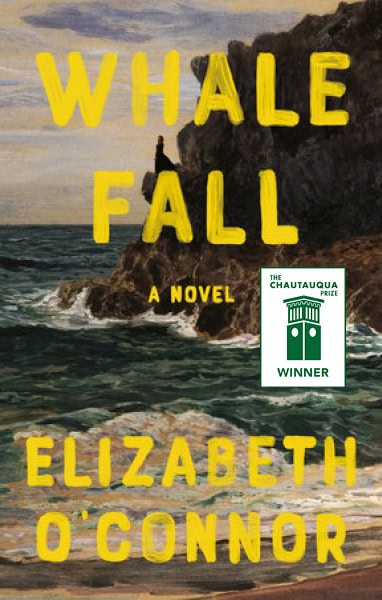
Chautauqua Institution proudly announces Whale Fall: A Novel (Pantheon Books) by Elizabeth O’Connor as the 2025 winner of The Chautauqua Prize.
Awarded annually since 2012, the Prize celebrates a book of fiction, literary/narrative nonfiction, or a book-length collection of poetry that provides a richly rewarding reading experience and honors the author for a significant contribution to the literary arts. As author of this year’s winning book, O’Connor receives $7,500 and will be presented with the Prize during a celebratory event and public reading at 3:30 p.m. EDT Friday, Aug. 15, in Chautauqua’s Hall of Philosophy.
O’Connor said she was deeply grateful and thrilled to accept the Prize this summer at the Institution. “I am profoundly honoured (and still in shock!) to have Whale Fall recognised by The Chautauqua Prize,” O’Connor continued. “It is especially meaningful from an organisation so dedicated to the arts, to lifelong learning, and to community, all things close to my heart and my writing.”
Whale Fall is a striking and sensual debut that defies simple genre classification. While it is a beautiful bildungsroman and work of historical fiction, it is also a study in anthropology, ethnography and folklore. It is a rich, metaphorical examination of the bones of what makes us human — history, culture, storytelling — against a backdrop of the literal bones of a decaying whale carcass washed ashore on the coast of Wales.
Winners & Shortlists
2025
Winner
Whale Fall: A Novel by Elizabeth O’Connor (Pantheon Books)
Finalists
- We’re Alone: Essays by Edwidge Danticat (Graywolf Press)
- No Road Leading Back: An Improbable Escape from the Nazis and the Tangled Way We Tell the Story of the Holocaust by Chris Heath (Schocken)
- By the Fire We Carry: The Generations-Long Fight for Justice on Native Land by Rebecca Nagle (Harper)
- The Fertile Earth: A Novel by Ruthvika Rao (Flatiron Books)
- The Light Eaters: How the Unseen World of Plant Intelligence Offers a New Understanding of Life on Earth by Zoë Schlanger (Harper)
- Load in Nine Times: Poems by Frank X Walker (Liveright)
2024
Winner
The Reformatory: A Novel by Tananarive Due (Saga Press)
Finalists
- Chain-Gang All-Stars: A Novel by Nana Kwame Adjei-Brenyah (Pantheon Books)
- Some People Need Killing: A Memoir of Murder in My Country by Patricia Evangelista (Random House)
- Enter Ghost: A Novel by Isabella Hammad (Grove Atlantic)
- This Other Eden: A Novel by Paul Harding (W. W. Norton & Company)
- White Cat, Black Dog: Stories by Kelly Link (Random House)
- Half-Life of a Secret: Reckoning with a Hidden History by Emily Strasser (University Press of Kentucky)
2023
Winner
The Song of the Cell: An Exploration of Medicine and the New Human by Siddhartha Mukherjee (Scribner)
Finalists
- The Black Period: On Personhood, Race, and Origin by Hafizah Augustus Geter (Penguin Random House)
- Border Hacker: A Tale of Treachery, Trafficking, and Two Friends on the Run by Levi Vonk with Axel Kirschner (Bold Type Books)
- A Down Home Meal for These Difficult Times: Stories by Meron Hadero (Restless Books)
- Four Treasures of the Sky: A Novel by Jenny Tinghui Zhang (Flatiron Books)
- Horse: A Novel by Geraldine Brooks (Viking Books)
- The Latecomer: A Novel by Jean Hanff Korelitz (Celadon Books)
- The Orchard: A Novel by Kristina Gorcheva-Newberry (Ballantine Books)
- Solito: A Memoir by Javier Zamora (Hogarth)
- Stories From the Tenants Downstairs by Sidik Fofana (Scribner)
2022
Winner
All the Frequent Troubles of Our Days: The True Story of the American Woman at the Heart of the German Resistance to Hitler by Rebecca Donner (Little, Brown and Company)
Finalists
- Facing the Mountain: A True Story of Japanese American Heroes in World War II by Daniel James Brown (Viking)
- Dear Memory: Letters on Writing, Silence, and Grief by Victoria Chang (Milkweed Editions)
- Damnation Spring by Ash Davidson (Scribner)
- The Prophets by Robert Jones, Jr. (Putnam)
- All That She Carried: The Journey of Ashley’s Sack, a Black Family Keepsake by Tiya Miles (Penguin Random House)
- Hell of a Book by Jason Mott (Dutton)
- Love and Fury: A Novel of Mary Wollstonecraft by Samantha Silva (Flatiron Books)
- The Agitators: Three Friends Who Fought for Abolition and Women’s Rights by Dorothy Wickenden (Scribner)
- Today a Woman Went Mad at the Supermarket: Stories by Hilma Wolitzer (Bloomsbury Publishing)
2021
Winner
Having and Being Had by Eula Biss (Riverhead Books)
Finalists
- The Bear by Andrew Krivak (Bellevue Literary Press)
- Deep Delta Justice: A Black Teen, His Lawyer, and Their Groundbreaking Battle for Civil Rights in the South by Matthew Van Meter (Little, Brown)
- How Much of These Hills is Gold by C Pam Zhang (Riverhead Books)
- Memorial Drive: A Daughter’s Memoir by Natasha Trethewey (Ecco)
- The Night Watchman by Louise Erdrich (Harper Collins)
- The Office of Historical Corrections by Danielle Evans (Riverhead Books)
- Transcendent Kingdom by Yaa Gyasi (Alfred A. Knopf)
2020
Winner
Out of Darkness, Shining Light by Petina Gappah (Scribner)
Finalists
- Tehran Children: A Holocaust Refugee Odyssey by Mikhal Dekel (W.W. Norton)
- What You Have Heard is True: A Memoir of Witness and Resistance by Carolyn Forché (Penguin Press)
- Feast Your Eyes by Myla Goldberg (Scribner)
- The Parisian by Isabella Hammad (Grove Press)
- Breathe: A Letter to My Sons by Imani Perry (Beacon Press)
- Bangkok Wakes to Rain by Pitchaya Sudbanthad (Riverhead Books)
2019
Winner
All the Names They Used for God: Stories by Anjali Sachdeva (Spiegel & Grau)
Finalists
- Little by Edward Carey (Riverhead Books)
- The Three Escapes of Hannah Arendt: A Tyranny of Truth by Ken Krimstein (Bloomsbury)
- Heavy: An American Memoir by Kiese Laymon (Scribner)
- The Overstory by Richard Powers (W.W. Norton)
- Rising: Dispatches from the New American Shore by Elizabeth Rush (Milkweed Editions)
- The Mercy Seat by Elizabeth H. Winthrop (Grove Press)
2018
Winner
The Fact of a Body: A Murder and a Memoir by Alex Marzano-Lesnevich (Flatiron Books)
Finalists
- Salt Houses by Hala Alyan (Houghton Mifflin Harcourt)
- High Noon: The Hollywood Blacklist and the Making of an American Classic by Glenn Frankel (Bloomsbury)
- The Futilitarians: Our Year of Thinking, Drinking, Grieving, and Reading by Anne Gisleson (Little, Brown)
- The Wanderers by Meg Howrey (G.P. Putnam’s Sons)
- The Signal Flame by Andrew Krivák (Scribner)
- The Worlds We Think We Know by Dalia Rosenfeld (Milkweed Editions)
2017
Winner
The Fortunes by Peter Ho Davies (Houghton Mifflin Harcourt)
Finalists
- The General vs. The President: MacArthur and Truman at the Brink of Nuclear War by H.W. Brands (Doubleday)
- Blood River Rising: The Thompson-Crimson Feud of the 1920s by Victoria Pope Hubbell (Iris Press)
- Underground Airlines by Ben H. Winters (Mulholland Books)
- American Character: A History of the Epic Struggle Between Individual Liberty and the Common Good by Colin Woodard (Viking)
- The Song Poet: A Memoir of My Father by Kao Kalia Yang (Metropolitan Books)
2016
Winner
Off the Radar: A Father’s Secret, a Mother’s Heroism, and a Son’s Quest by Cyrus Copeland (Blue Rider Press)
Finalists
- It’s What I Do: A Photographer’s Life of Love and War by Lynsey Addario (The Penguin Press)
- King of the Gypsies: Stories by Lenore Myka (BkMk Press)
- Granada: A Pomegranate in the Hand of God by Steven Nightingale (Counterpoint Press)
- Nagasaki: Life After Nuclear War by Susan Southard (Viking)
- No. 4 Imperial Lane by Jonathan Weisman (Twelve Books)
2015
Winner
Redeployment by Phil Klay (The Penguin Press)
Finalists
- The Map Thief by Michael Blanding (Gotham/Avery)
- Byrd by Kim Church (Dzanc Books)
- The Bully of Order by Brian Hart (HarperCollins)
- Euphoria by Lily King (Grove Atlantic/Atlantic Monthly)
- All Eyes Are Upon Us by Jason Sokol (Basic Books)
- The Scatter Here is Too Great by Bilal Tanweer (Harper)
- The Witch by Jean Thompson (Blue Rider Press)
2014
Winner
My Foreign Cities by Elizabeth Scarboro (Liveright)
Finalists
- A History of the Present Illness: Stories by Louise Aronson (Bloomsbury)
- Sea of Hooks by Lindsay Hill (McPherson & Company)
- The Boy Detective:
- A New York Childhood by Roger Rosenblatt (Ecco)
- The Man He Became: How FDR Defied Polio to Win the Presidency by James Tobin (Simon & Schuster)
- Wash by Margaret Wrinkle (Grove Press)
2013
Winner
Short Nights of the Shadow Catcher by Timothy Egan(Houghton Mifflin Harcourt)
Finalists
- Billy Lynn’s Long Halftime Walk by Ben Fountain (Ecco)
- The Presidents Club by Nancy Gibbs and Michael Duffy (Simon & Schuster)
- Devil in the Grove by Gilbert King (Harper)
- The Song of Achilles by Madeline Miller (Ecco)
- The Name of Things by John Colman Wood (Ashland Creek Press)
2012
Winner
The Sojourn by Andrew Krivak (Bellevue Literary Press)
Finalists
- Caleb’s Crossing by Geraldine Brooks (Viking)
- In The Garden of Beasts by Erik Larson (Crown)
- Why Read Moby-Dick? by Nathaniel Philbrick (Viking)
- All Cry Chaos by Leonard Rosen (The Permanent Press)
- We Are Taking Only What We Need by Stephanie Powell Watts (BkMk Press)
Eligibility
- Eligible books are those published first, or simultaneously, in the United States, in English, in 2025, and made available in hardcover or bound paperback form for purchase by the general public. Date of first publication, not copyright date, applies.
- Full-length books of fiction and narrative/literary nonfiction or poetry are eligible. Nonfiction may include history, science, religion, memoir, biography, journalism, and all sub-genres of creative nonfiction.
- Collections of short stories and collections of essays by one author are eligible.
- Only full-length, narrative/literary collections of poetry are eligible.
- Authors who have or have not been honored previously at Chautauqua Institution, and who have won or have not won other book awards, are eligible.
- Any author of an eligible book, including previous winners, is eligible for consideration each year.
- Authors are eligible to receive the prize without regard to nationality or residence.
- The author must be living at the time of the closing date for entries (November 30, 2025). In the case of a book by two authors, at least one of the authors must be alive on this date.
- Several chapters may have been published previously in magazines or journals, but most of the work must be original to the nominated book with the exception of short story and essay collections.
- The following books are not eligible:
- An English translation of a book written originally in any other language is not eligible.
- Self-published books are not eligible. Chautauqua Institution follows the guidelines set by the National Endowment for the Arts, which qualifies self-publishing as work from presses that: “require individual writers to pay for part or all of the production costs; require writers to buy or sell copies of the publication; publish work without competitive selection or a stated editorial policy; or publish work without professional editing.”
- Anonymous authors are not eligible.
- Anthologies containing work written by multiple authors are not eligible.
- A reprint of a book published in a previous award year is not eligible.
- In general, cookbooks, self-help books (including inspirational literature), reference books, picture books, or children’s books are not eligible.
In the event of a question as to eligibility, Chautauqua Institution will decide whether a book is eligible, and its decision will be binding. No correspondence will be required, and books and entry fees will not be returned.
Selected longlist authors and publishers will be notified in February, and will be required to:
- Agree that Chautauqua Prize winner must accept The Chautauqua Prize at Chautauqua Institution (if selected), on a date in summer 2026 at which time the prize winner will give a 30-minute acceptance/reading at an event held in their honor.
- Grant permission (if selected) to reproduce portions of the book for Chautauqua publicity purposes, with no additional remuneration.
- Grant permission (if selected) for Chautauqua Institution to film his or her acceptance talk, and make it available to the public, for sale or not for sale, with no additional remuneration.
- If selected for the short list, author and publisher agree that the book title and cover can be reproduced in press releases and prize announcements, with no additional remuneration.
Updated Sept. 3, 2025
Submission Requirements
After each nominated eligible book is evaluated by three Chautauquan reviewers, the shortlist and winner are chosen by an independent jury and two guest judges.
- Publishers (including trade, university, and small presses), agents, readers, or authors may submit books published in 2025 by living writers.
- The 2026 prize is open to any book of original fiction or narrative/literary nonfiction or poetry, written in English.
- Books must be published in the United States between January 1, 2025, and December 31, 2025. This means that the first publication must have been during that period. A paperback publication date does not count if that was not the first publication.
- Multiple entries may be submitted.
- Entries must include the following materials — no exceptions:
- An official entry form (or facsimile) for each title entered. Click here for a PDF download of the entry form.
- Eight (8) copies of each title entered, either published works or bound galleys.
- Official entry forms must be accompanied by the entry fee of $85, paid by the nominator and payable by check or money order to Chautauqua Institution.
- The postmark deadline for entry form is November 30, 2025. Books must be received by November 30, 2025.
- Nominators who wish the Institution to acknowledge receipt of their entry materials should enclose a self-addressed, stamped postcard or envelope.
- Longlist finalists are confidentially notified in February. At that time, they are asked to provide biographies and pictures, and to begin consideration of summer date(s) in which they could visit Chautauqua Institution to accept the award in person (a requirement of the prize winner). The winner and shortlist finalists are notified in May. They are also required to accept conditions noted as No. 9 below.
- Nominators agree that the decision of Chautauqua Institution and/or the judges will be final as to all matters, including eligibility, timelines of submissions, and compliance with these submission guidelines. Selected author and publisher must grant the permanent right in any and all media throughout the world to use all promotional and publicity rights in connection with their participation in the Chautauqua Prize competition, for use of their respective photographs, names, likenesses, voice, or appearances in connection with The Chautauqua Prize; and each consents to the permanent right of Chautauqua Institution to publish or broadcast the author’s acceptance speech without further consent or payment. Finalists grant the right that the book, author and publisher may be named in CHQ’s announcements.
- Books not accompanied by entry form will not be considered or returned.
- Nominators may send books by U.S. mail or express courier. Chautauqua Institution cannot be responsible for replacing items that are lost in transit. Nominators are encouraged to submit entries and copies well in advance of the deadline.
- Books will not be returned. Unused books, if any, will be donated to local public and school libraries as appropriate.
- Nothing in these guidelines shall be deemed to limit in any way the authority and control of Chautauqua Institution.
- For more information, please contact:
Stephine Hunt
Department of Education
Chautauqua Institution
P.O. Box 28
1 Ames Ave.
Chautauqua, NY 14722
716-357-6255
shunt@chq.org
Updated Sept. 3, 2025
Selection Process
- Each nominated eligible book is evaluated by three reviewers, representing a panel of Chautauquans who are writers, publishers, critics, editors, librarians, booksellers, and literature and creative writing educators. Books are distributed in a deliberate random fashion. If a reviewer self-discloses a concern that s/he cannot review a particular assigned book fairly, the submission is reassigned to a different reviewer.
- The reviewers read and recommend independently of each other and the staff at Chautauqua Institution.
- Books must be advanced for the finalist longlist by two of the three reviewers.
- Shortlist and winner are chosen by an independent jury comprising Chautauqua Institution staff leadership and guest judges. Each jury member may also advance one selection to the finalist longlist.
- The task of the jury is to select books that, in their opinion, best fulfill the purpose of the prize.
- The jury’s choice of winners is binding and final.
Updated Sept. 3, 2025
Literary Significance
Chautauqua Institution, dedicated to the exploration of the best of human values and to the enrichment of life, is the pre-eminent expression of lifelong learning in the United States.
More than 100,000 persons who visit Chautauqua during the 2026 season will note the honor of this selection, and The Chautauqua Prize winner and shortlist will be announced through broadcast, print and online media. Chautauqua’s singular multigenerational community offers artistic articulation, social and cultural conversations, and global and national interfaith and political awareness opportunities through approximately 2,200 events staged each summer at our lakeside location in western New York. Our national reach includes book clubs, civic and faith organizations, schools, libraries, and colleges and universities. International Chautauqua Literary and Scientific Circles include Japan, South Africa, and Zimbabwe.
Chautauqua attracts 4,000-plus in daily audiences for literary-themed weeks and special events:
- Literary-themed weeks in 2008, 2010, 2012, 2014, 2016, 2018, 2023, and 2025 with panelists and keynote speakers including Alan Alda, Julie Andrews, Margaret Atwood, Derek Bok, Sissela Bok, Tom Brokaw, Ada Calhoun, Billy Collins, E.L. Doctorow, Anne Fadiman, Jules Feiffer, Emma Walton Hamilton, John Irving, Norman Lear, Jim Lehrer, Alice McDermott, Marsha Norman, Joyce Carol Oates, Ann Patchett, Jane Pauley, Kim Stanley Robinson, Roger Rosenblatt, Maggie Smith, Elizabeth Strout, Amy Tan, Garry Trudeau, Meg Wolitzer.
- Recent special events and literary lectures include George Saunders (2025), Doris Kearns Goodwin (2025), Chris Hayes (2025), Javier Corrales (2025), Sayu Bhojwani (2024), Jamie Metzl (2024), Bill McKibben (2024), Frank Sesno (2024), Amy Tan (2024), Kate Bowler (2024), Kwame Alexander (2023), Elizabeth Kolbert (2021), Eddie S. Glaude Jr. (2021), Cheryl Strayed (2021), Jon Meacham (2020, 2024), David McCullough (2016), Anthony Doerr (2015), Margaret Atwood (2013), Billy Collins (2016, 2013 & 2010), Ted Kooser (2012), Dan Brown (2011), Stanley Fish (2011), Azar Nafisi (2011), Robert Pinsky (2009).
The Chautauqua Bookstore often sells hundreds of books for an individual book signing. The Chautauqua Bookstore reports sales to The New York Times. We also track our effect on Amazon.com. Thousands of sales result from a Chautauqua connection.
Chautauqua Literary and Scientific Circle, founded in 1878 and the oldest continuous U.S. reading course, honors nine to ten CLSC selections each summer, which feature book cover designation on onsite sales, author honorarium plus visit to Chautauqua, several hundred books sold at Chautauqua Bookstore, plus documented Amazon sales resulting from CLSC designation. Honored writers include Paul Beatty, Sandra Cisneros, Rita Dove, Joy Harjo, Viet Thanh Nguyen, David Treuer, Fredrik Backman, Maurice Carlos Ruffin, Geraldine Brooks, Susan Choi, Annette Gordon-Reed, Bill McKibben, Ha Jin, Joyce Carol Oates, Michael Ondaatje, Thomas Lynch, and Téa Obreht. Click here for a PDF download of the CLSC Historic Book List.
Chautauqua Writers’ Center, founded in 1987, offers 20-plus workshops each summer (from published writers who also teach writing), weekly readings and lectures, plus occasional presentations on publishing, book-to-film, writing for specific audiences, and collaborations with other Institution entities.
Special Studies classes (adult continuing education) attract more than 1,000 students in literature and writing courses each summer.
Literary programs are afforded opportunities for collaboration with other expressions of the arts on the Chautauqua Institution grounds, including Chautauqua Theater Company, Visual Arts at Chautauqua Institution, Everett Jewish Life Center at Chautauqua, and youth programs.
Updated Sept. 3, 2025
Readers of Chautauqua
From the toddler whose grandparents are helping choose her first book to the octogenarian devouring the uncountable, Chautauquans have an extraordinary involvement with the written word.
The Chautauqua Prize is distinctive in that its audience is a group of readers who grasp the relationship between the book and its audience, the author and the reader. The Chautauqua reader is compelled to question, and recognizes the sense of place, the sharply drawn character, and the storytelling power of a great work of fiction or literary/narrative nonfiction or poetry.
Updated Sept. 3, 2025
Relationships
- The Chautauqua Prize is separate from the other literary offerings of Chautauqua Institution. Authors and lecturers who have appeared previously at Chautauqua are eligible for The Chautauqua Prize.
- The book that wins The Chautauqua Prize, while not officially designated as a selection of the Chautauqua Literary and Scientific Circle, will count as a book that can be read for CLSC graduation and Guild of Seven Seals reading designations, which ensures continued readership into the future by thousands of active readers in this program.
- Books chosen as CLSC selections may be considered for The Chautauqua Prize, and Chautauqua Prize winners may be considered for CLSC selection, as long as all conditions for eligibility for selection in both programs are met.
- The obligation of the author who wins The Chautauqua Prize is an appearance and acceptance speech for the prize, with an optional public reading and book signing. If the winning author is asked for an Amphitheater, master class, or CLSC lecture, that appearance will be requested and compensated separately.
There is no other implicit or explicit relationship between The Chautauqua Prize and other Chautauqua Institution literary programs.